
OEM Jewelry Manufacturing: CAD Audit Before Tooling
The least costly design change you will ever make is the one that happens on a screen. TTT Jewelry publishes its 3D CAD stage at CAD three clocks run together: 48 hours for CAD, 25–30 days for sampling, then 3–4 weeks in production in production (production) for the run in production for the production run, so a mistake caught before the mould is cut costs review time instead of bench time. This page is the audit list for that file.
Key takeaways
- 3D CAD is published at under 48 hours and is the last stage where a change carries no tooling consequence.
- Master sampling runs 25–30 days and mass production 3–4 weeks, which puts a full first order near 7–9 weeks.
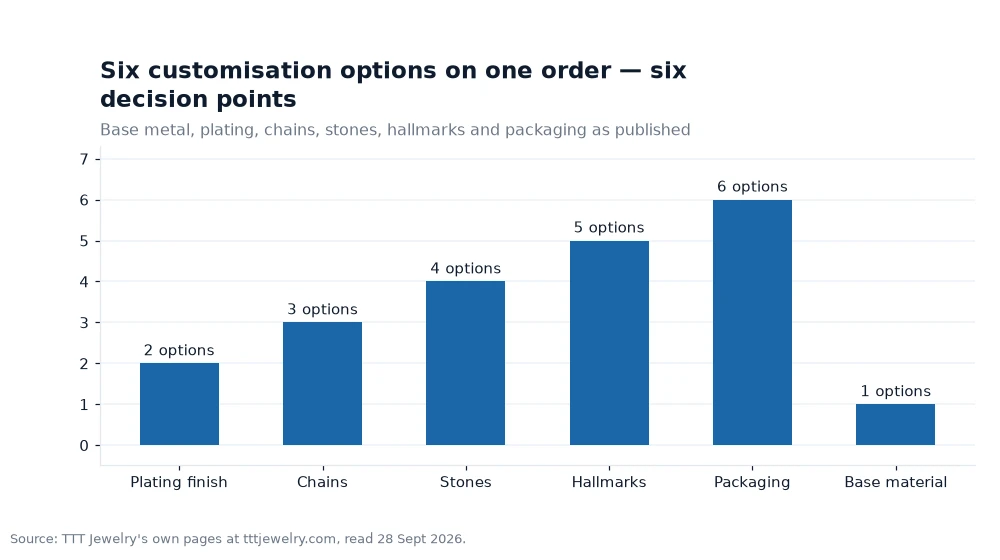
- Six customisation points are settled in the file: base material, plating, chains, stones, hallmarks and packaging.
- The ISO 9001:2015 standard, a BSCI social audit and REACH compliance on lead, cadmium and nickel are the papers to request alongside the drawing.
What the CAD stage hands back, and what it does not
A CAD package is three deliverables in one: a dimensional drawing you can measure, a realistic rendering for a buyer presentation, and a virtual rendering that stands in for photography before a sample exists. Under the OEM/ODM route the stage is quoted at under 48 hours, which is quick because no metal is involved yet — it is drawing, rendering and review.
What it does not hand back is certainty about weight, hand-feel, or how a stone behaves in a bezel. Those arrive with the 25–30 day master sampling window. So the file's real job is to remove every question that can be answered on a screen, and that is a short list of dimensions and placements rather than a matter of taste.
Six decision points hidden in one drawing
PVD vacuum plating on stainless steel, anti-tarnish e-coating for silver and brass, a rhodium layer and gold at 14K, 18K and 24K.
Most first orders decide two of the six deliberately and let the remaining four default to whatever the sample room assumes. An audit is simply writing all six down, confirming them, and having them reflected in the drawing before sign-off.
Why the 48-hour window carries the schedule
Compare the stages in the same unit. CAD is under 48 hours, sampling is 25–30 days, production is 3–4 weeks. Against a 25-day sample window, 48 hours is 48 ÷ 600 = 8% of that block; against 30 days it is 48 ÷ 720 ≈ 6.7%. Two days of screen work therefore sit inside a five-week schedule, and they decide how much of it is spent re-cutting or re-setting something.
The route and its stages are published on the manufacturer's own OEM/ODM page at https://www.tttjewelry.com/oem-odm-jewelry-manufacturer/, which is where the 48-hour figure, the sampling window and the minimum quantities on this page come from. Read it holding the six options, not as a sales page.
Auditing the drawing against the buyer, not the render
Renderings flatter a design. Hallmark placement is the classic case: an 18KGP mark on plated work, S925 on silver and 316L for stainless steel need a surface that survives polishing and stays legible on the finished piece, which usually means inside a band or beside a clasp rather than on the face.
Then check the parts a render does not show. Chains and findings are separate specifications with their own finishes; a stone setting needs a seat the setter can actually work in; packaging has five published components — a bar-coded labelling, backing cards, pouches in velvet or microfiber, a metallic logo tag and gift boxes stamped in foil — and the barcode decides whether a retail partner can receive the piece at all.
What the mould will not let you change later
Once the master is cut, the eight factory steps run in order: concept design, prototyping, sprue cutting, polishing, surface art, electroplating, final quality control and delivery. Relief detail, engraving placement, stone seats and chain holes are fixed by the mould, and the plating that follows only coats the surface the casting already has.
That is why a hallmark moved by two millimetres is a trivial edit during CAD and a new master afterwards — and a new master sits inside the 25–30 day window, not the 48-hour one. A 100% inspection pass catches defects; it cannot catch a decision.
The audit list to send back
Ask for the drawing with dimension callouts, the material named in writing, the plating route named (gold karat or rhodium, and whether the piece takes an anti-tarnish e-coating or PVD), the hallmark set and its placement, the chain and finding specification, the stone sizes and setting type, and the packing plan. Seven answers, one message.
Send it back with questions attached rather than approving silently. A 24-hour response window and a 1-on-1 dedicated project manager are standard on this route, and 100% NDA coverage keeps the file from being shared onward — two more reasons to ask early rather than guess.
| Stage | Published figure | What it decides |
|---|---|---|
| 3D CAD modelling | Under 48 hours | Everything you can still change cheaply |
| Master physical sampling | 25–30 days | The piece production will copy |
| Mass production | 3–4 weeks | Launch date and reorder planning |
| Minimum per design | 50 / 100 / 100+ pcs | Which base material the file can use |
| Final inspection | 100% inspected | What ships and what is held back |
Worked example: six decisions inside a 48-hour window
Fit the six customisation points into the published CAD window and the budget is 48 ÷ 6 = 8 hours per point, assuming you review them one after another and nobody waits on a reply. That is the whole allowance for material, plating, chains, stones, hallmarks and packaging.
The useful order is chronological rather than alphabetical. The minimums are 50 pieces in 925 silver, artisan eco-brass and stainless work, per design, so a two-design range doubles those figures. Plating is second because it dictates masking and handling. Packaging can wait until the sample is approved, because a pouch or a foil-stamped box does not touch the mould — only the carton.
The arithmetic worth keeping is that two days of CAD settle six decisions, and getting those six wrong costs five to six weeks of bench time to repair.
Frequently asked questions
Can an OEM order start without a CAD file?
Yes. Sketches, reference photos and tech packs are accepted inputs, and the drawing plus its renderings come back in under 48 hours for a dimensional sign-off.
At what point does a design change become expensive?
At tooling. While the file is on screen a revision is review time; once the master exists, the same change sits inside a 25–30 day sampling window.
Which parts of a piece can be customised?
Six: base material, plating and finish, chains and findings, stones and accents, logo and hallmark engraving, and packaging.
Booking tooling with the file already settled
An OEM order is won or lost in the two days before anyone touches metal. Get the drawing, the rendering and the six decisions checked in one pass, then send the file back with the minimums already agreed. The production floor page at the factory's own step list shows what happens once the mould is booked, and the questions buyers ask before a first order cover the rest.
Nothing here is invented — the approved-sample benchmark, then the confidentiality terms, the laser engraving option — all of it comes from the supplier's own site over at tttjewelry.com, as of 28 Sept 2026. Any conversion into other units is mine alone — the site supplies the inputs only[1].